


The finding of a single factor in a correlation matrix can nevertheless
be very meaningfull, provided that it is not immediately reified into
a specific unitary faculty. It means that, whatever factors play a role
in the emergence of the test scores, they play a role in the same way
for all tests. In that respect it is much more appropriate to use the
concept of test equivalence instead of the concept of
unidimensionality.
The concept of unidimensionality may easily suggest that a single,
unitary faculty is measured by the various tests. The concept of test
equivalence does not have this connation. A formal definition of test
equivalence has been given by by Lord & Novick (1968, p. 49-50). They
distinguish the concepts of  -equivalence and essentially
-equivalence. The definition of -equivalence is
given on page 49 and reads as follows:
-equivalence and essentially
-equivalence. The definition of -equivalence is
given on page 49 and reads as follows:
Distinct measuresand
of person i on measurement j and k are
(Lord & Novick (1968, p. 49, definition 2.13.5).
is the observed score of person i on measurement
j and  is the true score of person i on measurement j.
The true score(Lord & Novick (1968, p. 30, definition 2.3.1).
The definition of essentially -equivalence is
given on page 50 and reads as follows:
Distinct measures, where
is a constant (Lord & Novick (1968, p. 50, definition 2.13.8).
Note, that neither in the case of -equivalence, nor in the case of
essentially -equivalence  , that is,
the error variances are not necessarily equal. Both -equivalence
and essentially -equivalence are special cases of linearly
-equivalence, where linearly -equivalence is defined as
follows:
, that is,
the error variances are not necessarily equal. Both -equivalence
and essentially -equivalence are special cases of linearly
-equivalence, where linearly -equivalence is defined as
follows:
Distinct measures, where
both are constants.
For  and
and  , one obtains -equivalence and
for , one obtains essentially -equivalence.
If the additional assumption is made that
, one obtains -equivalence and
for , one obtains essentially -equivalence.
If the additional assumption is made that 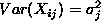 ,
then linearly -equivalence is equivalent with the unidimenional
factor analytical model. Therefore it is legitimate to use factor
analysis to the test the null-hypothesis of linearly -equivalence.
Note, that the factor loadings reflect the error variances
,
then linearly -equivalence is equivalent with the unidimenional
factor analytical model. Therefore it is legitimate to use factor
analysis to the test the null-hypothesis of linearly -equivalence.
Note, that the factor loadings reflect the error variances  .
.