The results were obtained from six different samples: two consisting
of male professional golf players, two consisting of female amateur
golf players and two consting of male amateur golf players. the amateurs
were all advanced golf players (handicap less then 25). The
tournaments were played on two different courses both situated at
the golf club "Het Rijk van Nijmegen" at Groesbeek near Nijmegen.
The golf courses are respectively known as the "Nijmeegse Baan" and
the "Groesbeekse Baan".
The professional tournaments were played within the framework of the
yearly Order of Merit tour. The first tournament was played in 1996
(1 and 2 june) at the Groesbeekse Baan and the second in 1997 (24 and 25
may) at the Nijmeegse Baan. These
professional tournaments are yearly recurring and are known as the SDH
Classic. They are organized by the Dutch Professional Golf Association.
The number of participants in 1996 was equal to 84. However, one of the
players was disqualified. So, the number of players which participated
both days was equal to 83. The number of participants in 1997 was equal
to 93. In order to obtain sufficient large samples the results of the
two days were merged together.
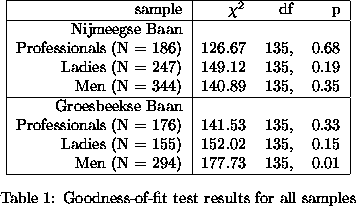
Table 1 contains the  goodness-of-fit statistics for
maximum likelihood extraction of one factor.
goodness-of-fit statistics for
maximum likelihood extraction of one factor.
In all cases the null-hypothesis of a single factor was not rejected,
except in the case of the sample consisting of male amateurs, Groesbeekse
Baan. The factor loading of hole five was relatively low. Moreover,
hole five is a very short par three hole. The other par three holes
are much longer. Therefore, hole five is a rather unique hole.
The supposition was made that the significant was caused by
hole five. Maximum likelihood factor analysis
with one factor in which hole five was omitted resulted in a
nonsignificant result (  ).
).
Analogous to Spearman's general factor in the case of mental tests, one might postulate a general golf factor in the case of golf holes. However, it is beyond any doubt, that many factors play a role in golf proficiency. Therefore, in the case of golf, the so-called golf g factor does clearly admit of resolution into a plurality of sub-factors. Stated somewhat differently, the statistical fact that hole inter-correlations can be accounted for by a single factor does not prove that such a factor represents any unitary power.
One might argue that separate entities in the mind or nervous system can never be measured by single tests or batteries of tests. It requires onle one example to contest this statement. Such an example could be the well-known Snellen test for visual acuity. This test has been the most popular clinical measurement of visual acuity for over a century. Visual acuity, as far as it is measured by the Snellen test, is directly related to the focal distance of the lens, which indeed is a unitary organ. If one would perform a factor analysis of different versions of the Snellen test (a letter form, a digit form, a figure form, etc.), one would certainly obtain a single factor, which would represent focal distance. If the different versions also would contain a color form with constant shape, then that version would disturb the single factor description of the correlation matrix, as color dicrimination is not determined by focal distance.